
01 Jul 2026
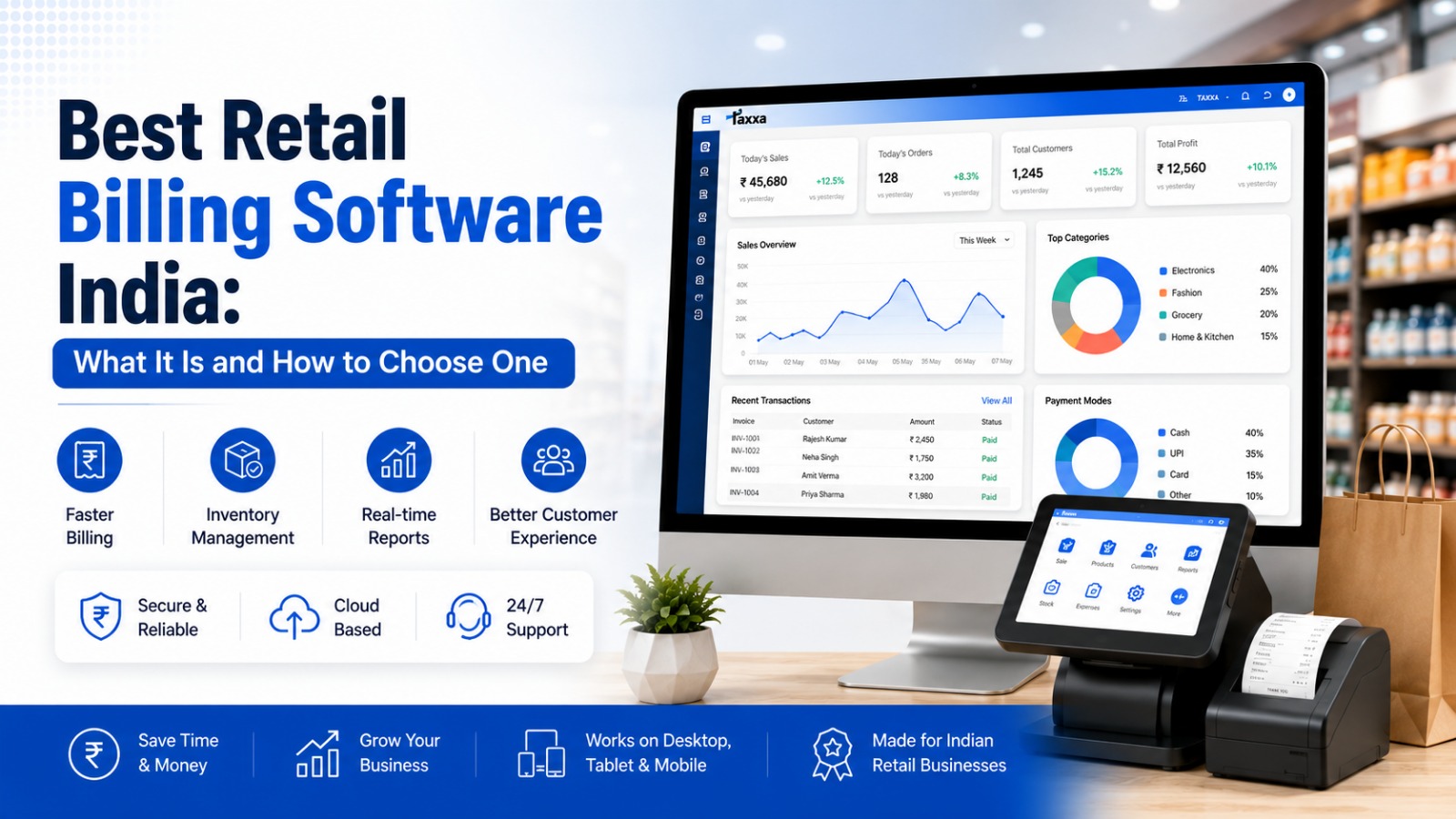
Walk into ten retail shops in any Indian city and you’ll find at least six still billing customers with a notebook, a calculator, or a dusty Excel sheet nobody’s touched since last Diwali. Everyone in the trade knows this. Almost nobody says it out loud.
That gap between what shop owners know they should be doing and what they’re actually doing is exactly why so many retailers start hunting for the best retail billing software India has to offer, usually right after a GST notice lands or the stock count refuses to match the shelf.
Retail billing software isn’t some fancy add-on for big chains anymore. It’s the difference between a shop that grows past fifty lakh a year in revenue and one that stays stuck at the same number for five years running. Here’s what it actually is, and how to pick one without burning a month on demos.
Retail billing software is a program, cloud-based mostly these days, that lets a shop generate bills, track stock, and stay GST-compliant without a mountain of loose paper.
Think of it as the digital upgrade to the old cash-counter register, except it also updates your inventory the second a sale happens and calculates tax without anyone doing mental maths at eight in the evening.
At its core, good retail billing software does three things every shop needs. It creates a bill in under a minute. It deducts the sold item from stock automatically. And it applies the right GST slab — five percent, twelve, eighteen, whatever the product needs — without the cashier having to remember which rate applies to what.
Platforms like Taxxa build all three into a single billing screen, so your staff isn’t switching between three different apps mid-queue.
Most retail billing software in India now runs on the cloud, and that matters more than it sounds. If the shop laptop crashes during a Saturday evening rush, cloud storage means your sales records survive. A purely offline, desktop-only system doesn’t offer that safety net.
Here’s the honest answer: manual billing is quietly expensive. A misapplied tax rate on fifty bills a day adds up to real money lost, either to the government in penalties or to your own margin because you undercharged.
Retailers in tier-2 and tier-3 cities feel this even more. Festive season alone — Diwali, Dussehra, wedding season in November — can push a single counter through 300-plus bills a day. Try doing that on a calculator without a mistake creeping in by six o’clock.
There’s also the trust factor. A customer who gets a proper GST invoice with your shop’s GSTIN, an item-wise tax break-up, and a clean printout trusts you more than one handed a scribbled chit. That’s not a small thing when word-of-mouth still drives most retail footfall in India.
And then there’s staff turnover — a real headache for small retailers. Good billing software with a simple interface means a new counter hire can bill accurately on day two, not week two.
There’s a cost angle too that often gets missed. A shop billing manually might spend forty-five minutes every night reconciling the day’s cash against handwritten entries.
Multiply that by three hundred working days, and you’re looking at well over two hundred hours a year spent on arithmetic that software handles in real time, for free, while the sale is still happening.
Not all billing tools are built the same, and the “best” one depends heavily on what your shop actually sells. That said, a few features separate genuinely useful software from a glorified calculator.
This isn’t optional anymore. Your software needs to generate GST-compliant invoices automatically, apply correct HSN codes, and — if your turnover crosses five crore rupees — support e-invoicing with IRN generation through the government’s Invoice Registration Portal.
Features like these are exactly what separates a real accounting-linked billing tool from a basic invoice-maker.
Every sale should reduce stock instantly, and every purchase should add to it. Without this, you’re doing physical stock counts every week just to know what you actually have — a genuine time sink for any shop carrying more than a few hundred items.
If you run more than one outlet — say, one in Bareilly and one in Lucknow — your billing software needs to show combined sales and stock across locations, not separate spreadsheets you reconcile by hand every month end.
A good system hands you profit and loss, best-selling items, and slow-stock reports with one click, instead of you exporting data to Excel and building pivot tables at midnight.
Especially for smaller shops or delivery-heavy businesses, being able to raise a bill from a phone — at the counter, at a stall, or on a home delivery run — is no longer a luxury feature. It’s expected.
Start with what you actually sell. A grocery store, a mobile shop, and a jewellery store have wildly different billing needs — barcode-heavy fast checkout versus high-value low-volume transactions versus serial-number tracking.
Compare pricing plans against what each tier actually unlocks, not just the headline number.
Ask about GST return support specifically. Can the software prepare GSTR-1 and GSTR-3B data, or does it stop at generating the bill? Many retailers get burned here, paying for billing software and then a separate accountant fee to manually re-enter everything at tax time.
Check whether the vendor offers Indian-language support and phone-based help, not just an email ticket system. When your Saturday rush hits and the software glitches, you want someone answering a call within minutes, not a two-day email wait.
If your accountant already works in Tally, ask whether the billing software syncs with it directly. Re-typing every day’s sales into Tally by hand at month-end is exactly the kind of duplicate work that good retail billing software is supposed to eliminate, not create.
Finally, ask for a real trial with your own products loaded in, not a generic demo. Software that looks great with sample data can behave very differently once it’s holding three thousand of your actual items.
GST compliance is where retail billing software earns its keep. As of 2026, e-invoicing is mandatory for businesses with aggregate turnover above five crore rupees in any financial year since 2017–18, and businesses crossing ten crore must report invoices to the government portal within thirty days of issue.
If you’re a growing retailer anywhere near that line, software that already handles IRN generation saves you a painful scramble later.
There’s a detail a lot of multi-outlet retailers miss: GST turnover is calculated at the PAN level, across all your outlets combined. A chain with three modest-looking stores in different cities can cross the threshold without anyone in the business noticing — until a notice arrives.
This is precisely the kind of blind spot dedicated retail accounting content covers in more depth.
Beyond e-invoicing, your software should handle routine GST tasks without drama — HSN-wise summaries, correct tax splits for interstate versus intrastate sales, and export-ready data for your CA at filing time. If it can’t do that, you’re not really running GST-compliant billing. You’re just hoping nothing gets checked.
The biggest one? Choosing purely on price. The cheapest plan often strips out GST filing support or caps your invoice count, and you find out only after your bills start bouncing back incomplete.
Second mistake: ignoring offline reliability. Internet in many parts of India still drops without warning, and a billing system that can’t create a bill offline — even temporarily — will cost you sales during outages.
Third, skipping the migration question. Ask upfront whether your existing customer list, stock data, and past invoices can move over.
Retailers who don’t check this end up rebuilding years of records from scratch, which is its own nightmare.
Fourth, and this one’s underrated — not testing customer support before buying. Software with a brilliant feature list but a support team that takes three days to reply isn’t really the best retail billing software for a busy shop. It just looks good on a features page.
Picking billing software isn’t a decision to rush through in an afternoon, and it’s definitely not one to make based on whichever salesperson called first. Your billing system touches every single sale your shop makes, which means a bad choice doesn’t just cost you money. It costs you time you’ll never get back re-entering data by hand.
The best retail billing software India has right now isn’t necessarily the one with the longest feature list. It’s the one that matches how your specific shop actually operates: your product mix, your store count, your staff’s comfort with technology, and your GST situation as it stands today and where it’s headed next year.
If you’re still comparing options, it’s worth checking what a purpose-built platform like Taxxa [IL-6 — Why Choose Taxxa] offers before settling on the first tool that shows up in a search. GST-ready billing, real-time stock tracking, and reports that don’t need an Excel wizard to interpret — that combination is what actually moves a shop from surviving to growing.
Start with a free trial, load in your real products, and see how it feels during an actual busy hour, not a quiet Tuesday afternoon. That’s the only test that tells you the truth. Ready to see it for yourself? Head to Taxxa at https://taxxa.in and set up your shop’s billing in under an hour.
It’s software that generates bills, updates stock, and applies GST automatically for retail shops, replacing manual registers and calculators at the counter.
Billing software focuses on invoices and stock at the counter, while accounting software covers ledgers and financial statements — the best tools now combine both.
It depends on your product range and store count, but look for GST-ready, cloud-based tools with mobile billing and strong support, like Taxxa.
GST-compliant invoicing is mandatory once you’re GST-registered, and e-invoicing kicks in above five crore turnover — billing software makes this far less error-prone.
Yes, most cloud-based retail billing software today supports multiple outlets from one dashboard, showing combined sales, stock, and reports across locations.
Pricing usually ranges from a few hundred to a few thousand rupees monthly, depending on features like GST filing, multi-user access, and inventory depth.
Yes, most modern retail billing software includes a mobile app or mobile-friendly interface, useful for counters, stalls, and home delivery runs.
Most reputable vendors support importing customer lists, stock data, and past invoices from Excel or competing software — confirm this before you switch.
No comments yet. Be the first to comment!