
05 Jun 2026
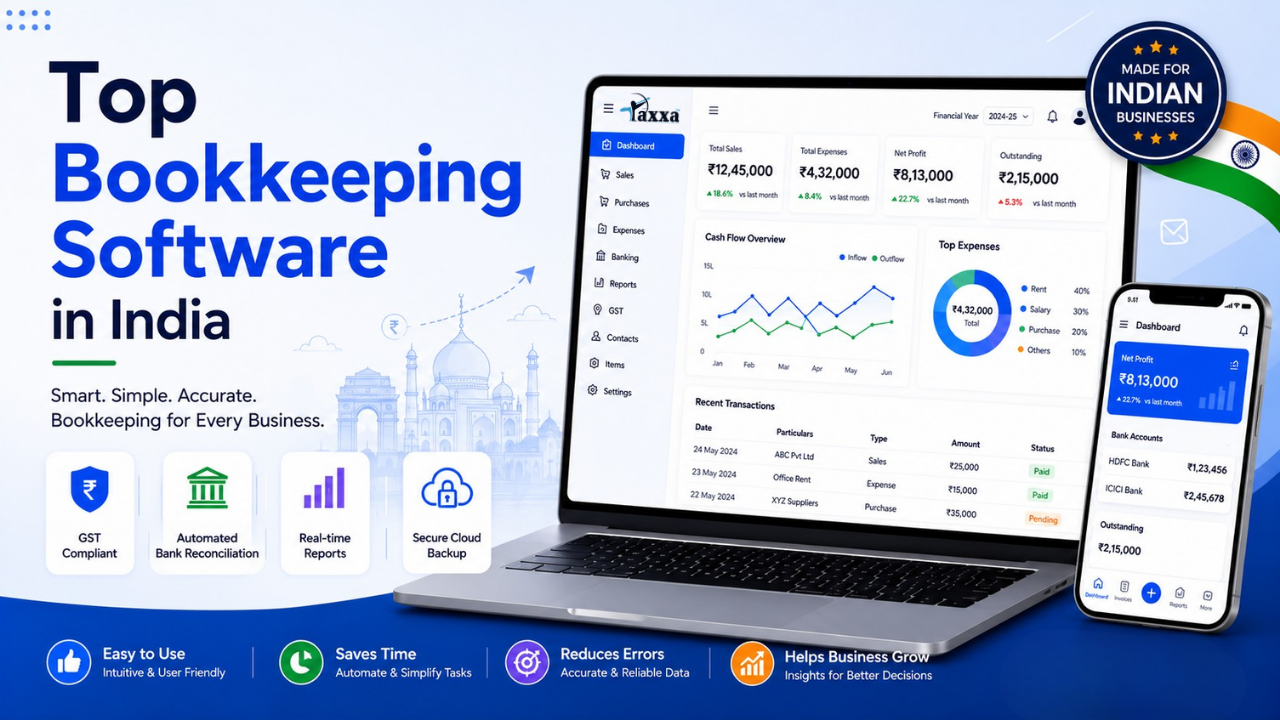
Most small business owners in India are still doing their bookkeeping the hard way—messy spreadsheets, paper registers, and last-minute panic every time GST filing is due. It doesn’t have to be that way.
The top bookkeeping software in India today does a lot more than just record transactions. It handles GST calculations automatically, generates invoices in seconds, tracks your inventory, and gives you a clear picture of your finances without needing a full-time accountant on payroll.
Whether you run a retail shop in Jaipur, a pharma distribution business in Mumbai, or a small manufacturing unit in Ludhiana, the right bookkeeping software can save you hours every week and keep you compliant without the stress.
This guide breaks down the best options available in India right now, what to look for, and why some tools are genuinely better suited to the Indian market than others. Let’s get into it.
India’s tax environment is more demanding than most. You’re dealing with GST returns every month or quarter, TDS deductions, e-invoicing mandates for certain turnovers, and the constant risk of a compliance notice if something’s off.
Manual bookkeeping simply can’t keep up. A single entry mistake in your GSTR-1 can cascade into reconciliation issues with GSTR-3B, and sorting that out can take days of your time (or your CA’s time—which costs money).
Good bookkeeping software isn’t just about convenience. It’s about keeping your business out of trouble with the GST department and making sure you always know where your money is going.
Spreadsheets don’t flag errors. They don’t remind you about due dates. They don’t auto-calculate GST on each line item or generate an e-way bill when a consignment crosses state lines. For businesses doing more than a few transactions a day, spreadsheets are a liability.
Software built specifically for Indian businesses—with Indian tax rates baked in, HSN codes loaded, and GSTR formats ready—removes most of this manual work entirely.
Not all accounting tools are built the same. A lot of international software—even well-known names—isn’t properly equipped for India’s GST structure. Here’s what actually matters:
This is non-negotiable. The software should support GSTR-1, GSTR-3B, GSTR-9, e-invoicing, and e-way bill generation. If you have to manually export data and reformat it for portal uploads, you’re wasting time the software was supposed to save you.
Your invoices need to carry HSN/SAC codes, GSTIN details, and tax breakdowns in the right format. Pre-built templates that are already compliant with Indian standards mean you don’t have to configure anything from scratch.
For traders and manufacturers especially, bookkeeping and inventory are inseparable. Stock that you can’t track becomes stock you lose money on. Look for software that connects your sales and purchase entries directly to your inventory.
Profit and loss, balance sheet, trial balance, and cash flow—these should be one click away. If your software makes you run multiple exports and stitch together a report manually, it’s not saving you much.
If you have even one employee handling accounts—or a CA who needs periodic access—multi-user login with controlled permissions is essential. You don’t want everyone seeing everything, and you don’t want to share a single password either.
Here’s a look at the main options. Indian businesses rely on right now, along with what each one does well and where it falls short.
Taxxa is one of the newer names on this list, but it’s quickly gaining traction among small and medium businesses across India. It’s a cloud-based GST accounting and billing software developed specifically for the Indian market—trusted by over 25,000 businesses.
What makes Taxxa stand out is how complete it is at its price point. You get GST invoicing with HSN/SAC codes, GSTR-1, GSTR-3B, and GSTR-9 filing, TDS management, e-invoicing, e-way bill generation, inventory tracking, bank reconciliation, and full financial reports—all in one platform.
The interface is clean and doesn’t assume you have an accounting background. It’s been designed with input from Chartered Accountants, so the workflows actually match how Indian businesses and CAs operate—not how some Silicon Valley product manager imagined they might.
Taxxa also has a mobile app for Android and iOS, which means you can raise invoices, check stock levels, or review payment status from anywhere. The real-time bookkeeping sync means every transaction—sales, purchase, and payment—updates your records instantly without manual steps.
Best for: Small and medium businesses, retailers, manufacturers, pharma distributors, restaurants, and CA firms looking for an affordable all-in-one solution.
Pricing: Multiple plans are available including a free trial. Visit taxxa.in for current pricing details.
Tally has been part of Indian accounting since the 1990s. Most CAs know it, most accounting staff have been trained on it, and it handles GST compliance reasonably well for most business types.
The main drawbacks: it’s desktop-first, not cloud-native, and the interface feels dated. The learning curve is steeper than modern cloud alternatives, and getting remote access requires additional setup. For businesses wanting anywhere access, it can be limiting.
Best for: Businesses where staff is already trained on Tally, or where a CA has standardised on it.
Zoho Books is a solid cloud accounting tool with good GST support, clean UI, and strong report generation. It integrates well with other Zoho products like Zoho CRM and Zoho Inventory if you’re already in that ecosystem.
It’s priced a bit higher than some domestic alternatives at the equivalent feature level, and smaller businesses often find themselves paying for features they don’t use. The free plan is quite restricted.
Best for: Businesses already using the Zoho suite, or those needing CRM + accounting integration.
QuickBooks is popular globally but is not the best fit for Indian GST compliance. The Indian version has improved, but many businesses find it requires workarounds for some GST scenarios. Support for Indian-specific requirements isn’t as deep as domestic tools.
Best for: Businesses with global operations or clients, where Indian GST is only part of a larger accounting need.
Busy is well-known among trading and distribution businesses in India, particularly in sectors like pharma, FMCG, and wholesale. It handles multi-location inventory and billing well. Like Tally, it’s traditionally desktop-oriented, though cloud versions are now available.
Best for: Distributors, traders, and businesses with complex inventory across multiple locations.
Marg is heavily used in pharma distribution across India. It handles batch tracking, expiry management, and pharmacy-specific billing well. For businesses outside pharma or retail, it may feel over-engineered for their needs.
Best for: Pharma distributors, medical shops, and FMCG retailers.
There’s no single answer that fits every business. The right bookkeeping software depends heavily on what kind of business you run.
You need fast billing, GST invoicing, and inventory tracking without a steep learning curve. A cloud-first tool like Taxxa that works on mobile and desktop lets you manage operations even if you’re not at the counter.
Manufacturing adds complexity — production entries, raw material consumption, finished goods, job work challan. Make sure your software has a proper manufacturing module, not just a workaround through general inventory.
If you’re in consulting, security services, tours and travel, or any service-heavy sector — your invoicing needs are simpler than a product business, but GST on services and TDS compliance matter a lot. A clean, fast invoicing tool with GST filing is what you’re after.
CAs managing multiple clients need software with clear client separation, robust reporting, and filing capabilities across GSTR forms, TDS returns, and financial statements. Multi-user access with different permission levels is practically mandatory.
People make similar errors when picking bookkeeping software. It’s worth knowing them before you commit.
Pricing varies widely. Some tools charge per user, some charge per transaction, some have flat annual fees. Here’s a rough picture:
Basic cloud accounting tools for very small businesses can start from a few hundred rupees per month. Mid-range tools with full GST compliance, inventory, and multi-user support typically range from ₹2,000 to ₹8,000 per year depending on features and the number of users.
If you’re paying a CA ₹500–₹1,500 per hour to clean up messy books or redo incorrect GST filings, a software subscription that prevents those problems pays for itself very quickly. The ROI calculation is usually straightforward.
More importantly: consider what your time is worth. If you’re spending 10 hours a month on manual bookkeeping, software that cuts that to 2 hours saves 8 hours — time better spent running the actual business.
Taxxa, for instance, offers transparent pricing with a free trial so you can evaluate the features before committing. That kind of try-before-you-buy approach is exactly right for a purchase decision like this.
What is bookkeeping software, and how is it different from accounting software?
Bookkeeping software handles the recording of financial transactions — sales, purchases, payments, receipts, and inventory. Accounting software typically includes bookkeeping plus higher-level features like financial statement preparation, auditing tools, and tax filing. In practice, most tools sold as “accounting software” in India include both functions. The distinction matters less than making sure the specific features you need are actually there.
Is it mandatory to use GST-compliant bookkeeping software in India?
It’s not legally mandatory to use a specific software, but your bookkeeping must produce GST-compliant records and reports for filing. Since GSTR-1 and GSTR-3B require transaction-level data in specific formats, and e-invoicing is mandatory above certain turnover thresholds, using software that generates this automatically is highly practical. Doing it manually is not only time-consuming — it’s prone to errors that can lead to notices from the GST department.
What is the best bookkeeping software for a small business in India?
For most small businesses in India, a cloud-based solution with full GST support, invoicing, inventory, and reporting is the most practical choice. Taxxa is a strong option — it’s designed for the Indian market, trusted by over 25,000 businesses, endorsed by CAs, and doesn’t require any accounting background to use. Other options like Zoho Books and Tally Prime are also widely used, depending on your specific needs and budget.
Can I file GST returns directly from bookkeeping software?
Yes — many Indian bookkeeping tools support direct GST return filing. Taxxa, for example, lets you prepare and file GSTR-1, GSTR-3B, and other returns directly from the software, including error checks before submission. This saves a significant amount of back-and-forth with your CA and reduces filing errors.
What is e-invoicing and which businesses need it?
E-invoicing (electronic invoicing) is a system where B2B invoices are authenticated in real time by the GST Network (GSTN) and assigned an Invoice Reference Number (IRN). It’s currently mandatory for businesses with annual turnover above a certain threshold (the limit has been progressively lowered over time — check the GST portal for the current applicable limit). Your bookkeeping software needs to support e-invoice generation and IRN fetching. Most modern Indian accounting tools, including Taxxa, support this.
Is cloud-based bookkeeping software safe for my business data in India?
Reputable cloud-based accounting software uses data encryption, secure cloud storage, and regular backups. The risk of data loss on a properly maintained cloud platform is significantly lower than keeping data on a single desktop computer. That said, choose providers who have clear data protection policies. For Indian businesses, it’s also worth checking whether the data is stored on Indian servers, as some businesses prefer this for compliance reasons.
Bookkeeping isn’t glamorous. Nobody starts a business because they love reconciling bank statements or preparing GSTR returns. But the businesses that stay on top of their numbers—and stay compliant—consistently outperform the ones that don’t. Software is what makes that manageable.
The top bookkeeping software in India right now gives small and medium businesses capabilities that only large companies could afford a decade ago. Real-time financial reporting. Automated GST filing. Mobile invoicing. The playing field has leveled significantly—but you have to actually use these tools to benefit from them.
When evaluating options, don’t just look at the feature list. Look at how well the software handles India-specific requirements—GST, TDS, e-invoicing, Indian date formats, and INR currency handling. A tool that looks great internationally but struggles with your monthly GSTR-3B reconciliation isn’t doing its job.
Taxxa was built specifically for Indian businesses from the ground up—not adapted from a global product. With 25,000+ businesses already on the platform, a mobile app, a CA endorsement, and a free trial to get started, it’s a strong first choice for most small and medium businesses looking to modernize their bookkeeping. If you’re ready to stop guessing and start managing your accounts with clarity, visit Taxxa at taxxa.in and see what properly built Indian bookkeeping software looks like.
No comments yet. Be the first to comment!