
11 Jul 2026
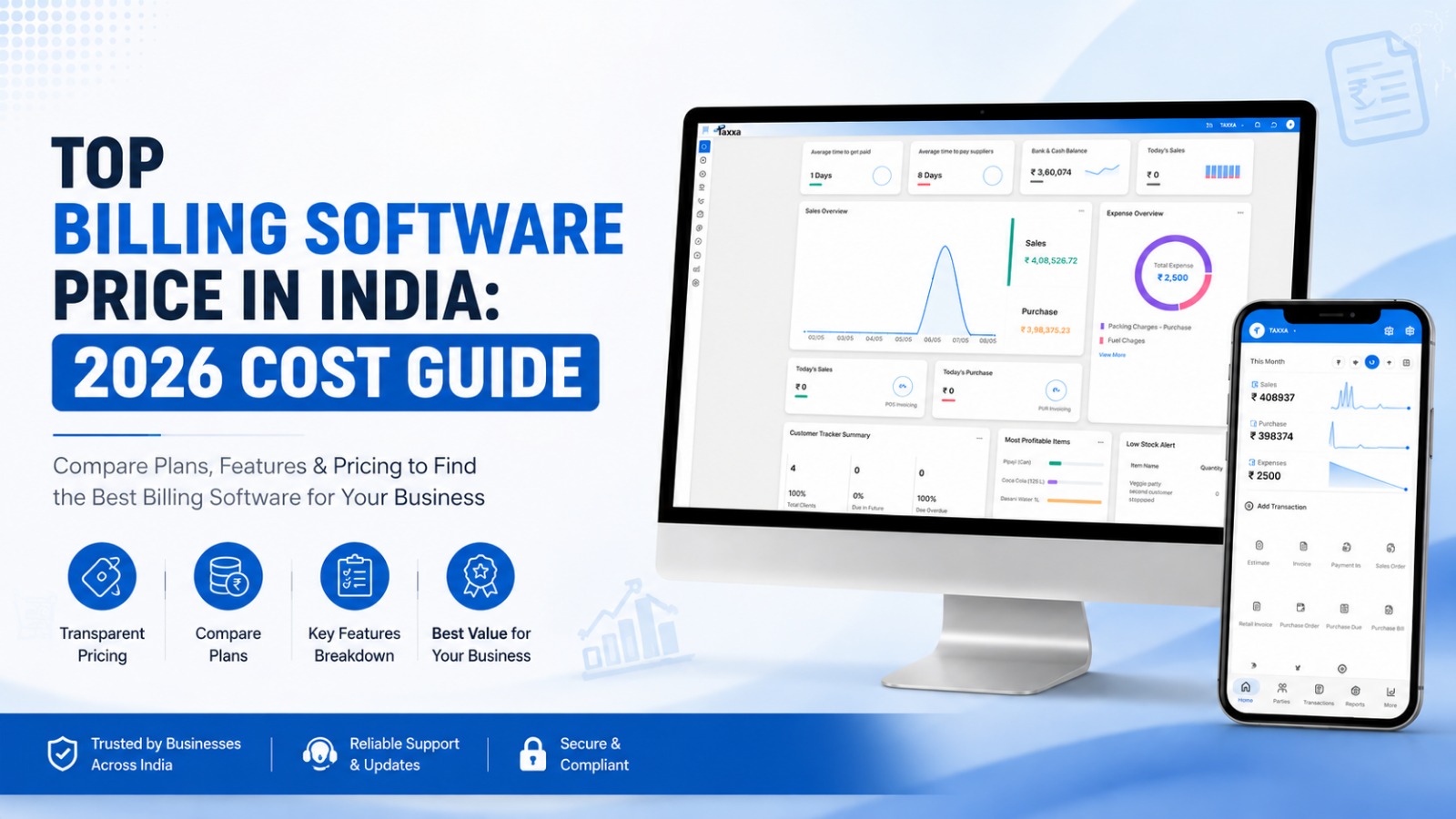
GST e-invoicing becomes mandatory the moment a business crosses ₹5 crore in annual turnover, yet a huge number of Indian shop owners are still deciding between a ₹500 notebook and a ₹2,000-a-year app. That gap says everything about how confusing billing software price in India has become.
Every vendor quotes its numbers differently. One plan is billed per year, another per user, and a third throws in “unlimited invoices” until you actually read the fine print. Compare that to buying a phone, where the price tag on the box is the price tag you pay.
This guide breaks down what billing software actually costs in India today, plan by plan, so you’re not the last person in your trade group still asking “which one is cheaper?” three months from now.
Here’s the short version before we go deep. Taxxa’s entry plan starts at ₹2,000 a year per business, and its Professional tier with GST filing and e-way bills sits around ₹6,000 a year. Vyapar’s Silver plan starts near ₹1,999 a year for Android-only billing. myBillBook charges roughly ₹33 a month for its cheapest Android plan, with cross-platform access starting around ₹2,599 a year.
Zoho Books offers a genuinely free plan for businesses under ₹50 lakh turnover, though its paid Standard tier runs about ₹749 a month. TallyPrime sits at the expensive end, with desktop licences starting from roughly ₹22,500 as a one-time cost.
So if you’re only comparing sticker prices, cloud billing software built for India — like Taxxa, Vyapar, and myBillBook — will almost always beat legacy desktop software. But sticker price isn’t the whole story, and we’ll get to that shortly.
Taxxa runs a simple four-tier structure, and it’s built specifically around what Indian small businesses and GST-registered shops actually need. The Basic plan costs ₹2,000 for one year per business, covering one user, custom invoice branding, credit and debit notes, stock management, and 25-plus standard reports.
Step up to Professional and you’re at ₹6,000 a year, which unlocks three businesses, three users, online GST filing, delivery challans, purchase and sales orders, and 15 e-way bills a month. Growth, at ₹12,000 a year, adds Tally integration, barcode support, recurring invoices, and priority support — useful once you’re running five businesses or need TDS and TCS reports.
There’s also multi-year pricing if you’d rather lock in a rate: three years of Basic costs ₹4,000 total, which works out cheaper per year than paying annually. You can check the exact numbers and feature breakdowns on the Taxxa pricing page before deciding which tier fits your billing volume.
Vyapar and myBillBook both target the same crowd — kirana stores, distributors, and small traders who want GST billing without a steep learning curve. Vyapar’s Silver plan starts around ₹1,999 a year, but it’s Android-primary; desktop access sits in a higher tier, which catches a lot of first-time buyers off guard.
myBillBook plays it differently. Its cheapest paid option is close to ₹33 a month for Android-only billing, while the Diamond plan at roughly ₹2,599 a year is the first one that includes web and iOS access together. If your staff bills from a laptop at the counter and checks stock from a phone at home, you’ll likely need that higher tier, not the entry-level price you saw in the ad.
Neither app is “wrong” on price. The trick is matching the plan to how your team actually works, not to whichever number appears first on the pricing page.
Zoho Books’ free plan is a genuinely good deal, covering GST invoicing and basic reporting for businesses under ₹50 lakh turnover. Once you outgrow that — 1,000 transactions a year fills up faster than most owners expect — Standard jumps to about ₹749 a month, and Professional lands near ₹17,686 a year with inventory and project billing included.
TallyPrime remains the name every CA in India recognises, and that reputation comes at a price. Licences start around ₹22,500 as a one-time cost, which sounds cheaper than a subscription until you factor in add-on modules, annual maintenance fees, and the training time your staff needs to learn its keyboard-driven interface.
Marg ERP sits in a similar bracket for pharma and distribution businesses, where its industry-specific templates justify the higher spend. If your business genuinely needs deep accounting rather than fast counter billing, this tier can be worth the extra rupees. If you just need to raise a GST invoice in ten seconds flat, it probably isn’t.
The plan you see advertised is rarely the plan you end up paying for, and that’s true across nearly every vendor on this list. Extra users almost always cost more — Zoho charges roughly ₹149 per additional user per month, and most cloud billing apps follow a similar model.
E-way bill and e-invoice limits are another quiet cost driver. Taxxa’s Professional plan includes 15 e-way bills a month, and once you cross that, you either upgrade a tier or pay per-document charges depending on the vendor. GST filing itself is sometimes bundled and sometimes an add-on, so it’s worth checking before you assume it’s included.
Then there’s GST on the software itself — every legitimate vendor adds 18% GST to the quoted price, which is easy to forget when you’re mentally comparing two numbers. Multi-year plans usually work out cheaper per year than paying annually, so if you’re confident about sticking with one vendor, that’s where the real savings sit.
Migration is the cost nobody puts on a pricing page. Moving your customer list, opening stock, and old invoices from a notebook or a different app takes real time, and some vendors charge for assisted onboarding while others include it for free. It’s worth asking before you sign up, not after your first GST return is already due.
Support tier changes what you effectively pay too. A plan that looks ₹1,000 cheaper on paper but leaves you stuck on email-only support during a filing deadline isn’t really the cheaper option — it just moves the cost from your invoice to your evening.
A handful of checks will save you from picking the wrong tier:
Taxxa’s Growth and Custom tiers, for instance, include priority and dedicated manager support, which is worth something the day your GST filing deadline is tomorrow morning. If you want to see how the feature set lines up against the price before you commit, the Taxxa features page lays out what’s included at every tier without the sales pitch.
It’s also worth reading through what small businesses choosing Taxxa actually get for their money, since real usage patterns tell you more than a spec sheet ever will.
Billing software price in India isn’t really about finding the cheapest number on a page — it’s about finding the plan where the price and your actual invoice volume line up. A ₹2,000 basic plan that covers everything you need beats a ₹12,000 plan sitting mostly unused.
Most Indian small businesses overpay in one of two ways: they buy more tier than they use, or they buy a cheap plan and then get hit with add-on charges for e-way bills and extra users every single month. Neither mistake is expensive to avoid once you know what to check before signing up.
Taxxa’s pricing is built to stay predictable — no surprise per-document charges within your tier, no hidden GST filing fee, and multi-year plans that lock your rate for up to three years. That predictability matters more than a slightly lower headline price once you’ve been burned by a vendor’s fine print once already.
If you’re still comparing options, start with a free trial rather than an annual commitment. Visit Taxxa to see the current plans, or reach out through the partner page if you’re a CA or reseller looking to offer GST billing software to your own clients.
Q1. What is the cheapest billing software in India?
myBillBook (₹33/month) and Vyapar (₹1,999/year) are among the cheapest paid, Android-only options. Taxxa’s Basic plan at ₹2,000/year is close behind and adds desktop-friendly stock management and reports.
Q2. Is there any free billing software for GST invoicing?
Yes, Zoho Books is free for businesses under ₹50 lakh turnover, covering GST invoicing and basic reporting. It’s capped at 1,000 transactions a year with just one user and one accountant login.
Q3. Does Taxxa charge extra for e-way bills?
No. Professional includes 15 e-way bills a month and Growth includes 50, both within the quoted price. The Custom plan removes the cap for high-volume businesses.
Q4. What’s the difference between Vyapar and myBillBook pricing?
Both start as Android-only plans. myBillBook’s Diamond tier (₹2,599/year) is the first to add web and iOS access, while Vyapar’s desktop access sits in a separate, higher tier.
Q5. Is Zoho Books really free for small businesses?
Yes, as long as turnover stays under ₹50 lakh and you’re within 1,000 transactions a year. Beyond that, you move to Standard at roughly ₹749/month.
Q6. How much does Tally cost compared to cloud billing apps?
TallyPrime starts around ₹22,500 as a one-time desktop licence, well above a cloud plan’s annual cost. Over three years, cloud apps usually still work out cheaper once you add Tally’s maintenance fees.
Q7. Do billing software prices include GST?
Usually not. Most vendors quote a base price and add 18% GST at checkout, so always check the final billed amount, not just the listed number.
Q8. Which billing software gives the best price-to-feature ratio for small shops?
For single-counter GST billing and stock tracking, Taxxa’s Basic or Professional plan covers the essentials affordably. Larger multi-branch businesses may get more value from Zoho Books’ or Tally’s higher tiers.
Q9. Was this content checked for originality and AI writing?
Yes, this article was checked on QuillBot AI Content Detector (quillbot.com/ai-content-detector) and DupliChecker (duplichecker.com), targeting 0% on both. Pricing was cross-checked against vendor pages at the time of writing.
No comments yet. Be the first to comment!